> For the complete documentation index, see [llms.txt](https://doc.wearepatchworks.com/product-documentation/llms.txt). Markdown versions of documentation pages are available by appending `.md` to page URLs; this page is available as [Markdown](https://doc.wearepatchworks.com/product-documentation/patchworks-services/inbound-api/using-the-inbound-api-connector-with-patchworks-services/generating-token-credentials-for-api-access.md).
# Generating token credentials for API access
## Introduction
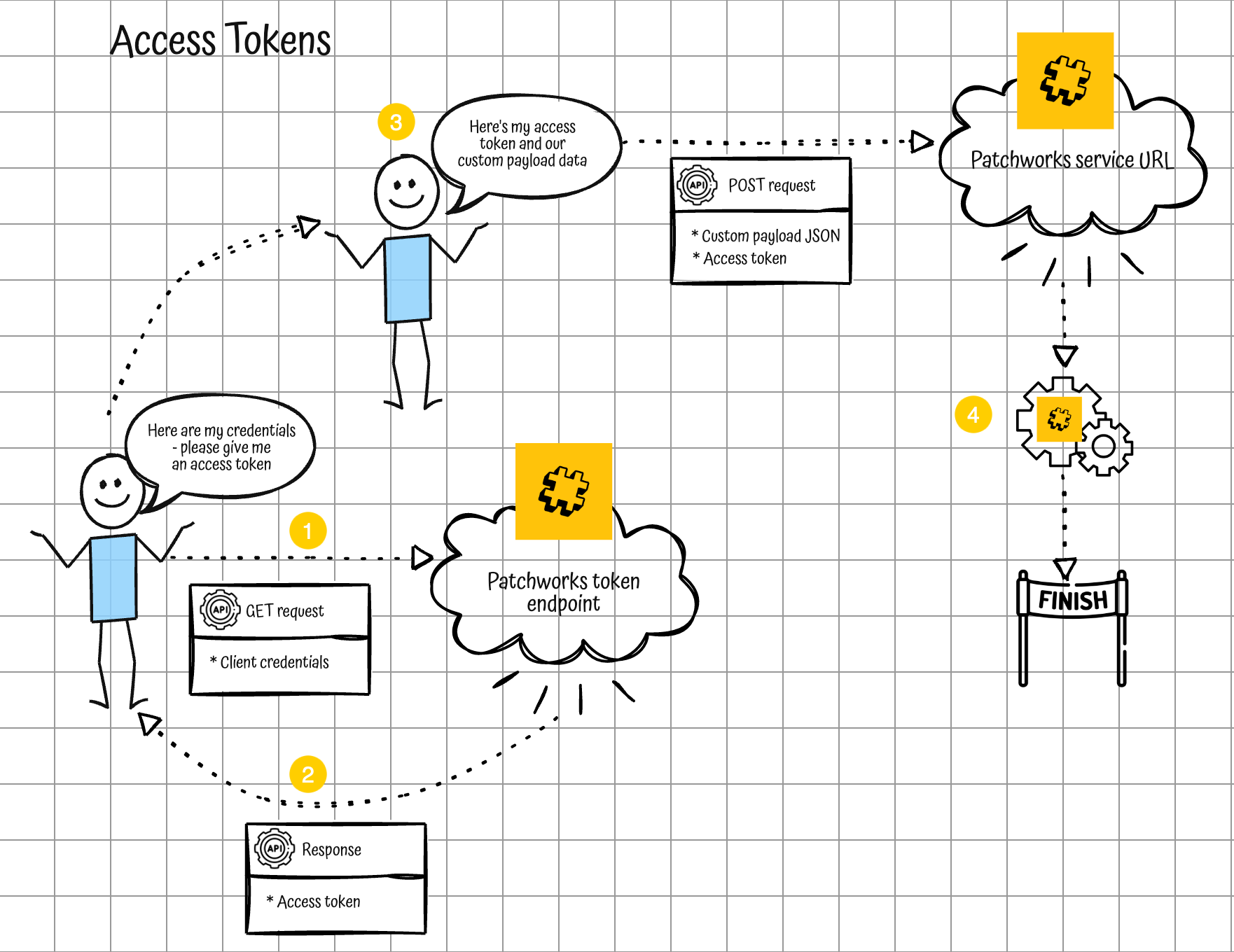
A Patchworks **access token** is required to authorise API requests for sending data to the inbound URL for a Patchworks service.
To obtain this token, you send a set of **client credentials** to a Patchworks **token endpoint**. Patchworks validates these credentials and returns an **access token** you can use to POST custom payload data to the required service. Once the custom payload is received, it’s processed in the usual way.These steps are illustrated below:
{% hint style="info" %}
Access tokens are valid for 24 hours - for example: Issued: Wednesday 20th July at 10:03:08 GMT Expires: Tuesday 21st July at 10:03:08 GMT.
{% endhint %}
Use the **authentication** tab for an **Inbound API connector** to obtain/generate details required to request access tokens for secure access to the inbound URL for a Patchworks service. You will need:
* A Patchworks token endpoint
* OAuth credentials for this endpoint
{% hint style="info" %}
Patchworks uses **OAuth 2.0**. Watch this space for **Basic Authentication** support, coming soon!
{% endhint %}
## Prerequisites
To complete the steps detailed here, you must have completed the following tasks:
* [Adding an Inbound API connector with a custom payload](/product-documentation/patchworks-services/inbound-api/using-the-inbound-api-connector-with-patchworks-services.md)
## The steps
Follow the steps below:
**Step 1**\
Select the **authentication** tab for the required **Inbound API Connector**:

These steps assume you are following a 'create new' connector flow. If you need to use an existing connector, find the required connector and select the **authentication** tab:

**Step 2**\
Copy the **token endpoint** and paste it somewhere safe for future use:

… when prompted, enter a name for this set of credentials:

**Step 3**\
Move down to the **OAuth2 Clients** section and select **create an OAuth2 client**:

… when prompted, enter a name for this set of credentials:

**Step 4**\
Click the **create new OAuth2 client** button to confirm and display generated credentials:

**Step 5**\
Copy/paste this information somewhere safe for future use.
{% hint style="danger" %}
Once this page is closed, you can’t reaccess the client secret. If you lose this information, you need to generate a new set of credentials.
{% endhint %}
**Step 6**\
Click the **close** button to exit back to the connector **authentication** tab, where the new set of credentials is listed:

**Step 7**\
You are now ready to add a Patchworks service - see [Adding a Patchworks service for an Inbound API connector](/product-documentation/patchworks-services/inbound-api/using-the-inbound-api-connector-with-patchworks-services/adding-a-patchworks-service-for-an-inbound-api-connector.md).