# Viewing current blueprint installations

## Introduction

The `installs` page shows all existing installations of a blueprint, with options to forcibly [promote/demote](/product-documentation/blueprints/working-with-private-blueprints/rolling-out-blueprint-updates/bulk-blueprint-updates-force.md) a specific version, or the [active version](/product-documentation/blueprints/working-with-private-blueprints/changing-the-active-version-for-a-private-blueprint.md), to selected installations.&#x20;

You can also drill down to the details of a bulk installation to [check the status of associated updates](#installation-details) (either during or after completion), and you can even [cancel pending updates](#cancelling-pending-updates).

## Accessing the installs page

{% stepper %}
{% step %}
**Log in to your own company profile**

Log in to the dashboard and (if you're managing multiple company profiles) ensure that you've [switched to your own profile](/product-documentation/company-management/multi-company-profiles/switching-in-and-out-of-a-linked-company.md).
{% endstep %}

{% step %}
**Access private blueprints**

Select `marketplace` from the left-hand navigation menu, then select `blueprints` and `private` tabs. Here you will see any blueprints that have been built by users associated with your company profile.
{% endstep %}

{% step %}
**Select the required blueprint**

Click the blueprint tile that you want to manage. For example:

<figure><img src="/files/OaGapMosseWVLXuQaQxS" alt=""><figcaption></figcaption></figure>

The blueprint manifest is displayed. For example:

<figure><img src="/files/Klms7xNcTciS5qBKulD3" alt=""><figcaption></figcaption></figure>
{% endstep %}

{% step %}
**Select view installs**

Click the ellipsis icon at the top of the page:

<figure><img src="/files/mZy9NkFF41JnxFIklIMG" alt=""><figcaption></figcaption></figure>

Then select the `view installs` option:

<div align="left"><figure><img src="/files/HyfuW8FXGn2G9uruNu5B" alt=""><figcaption></figcaption></figure></div>
{% endstep %}
{% endstepper %}

## Understanding the installs page

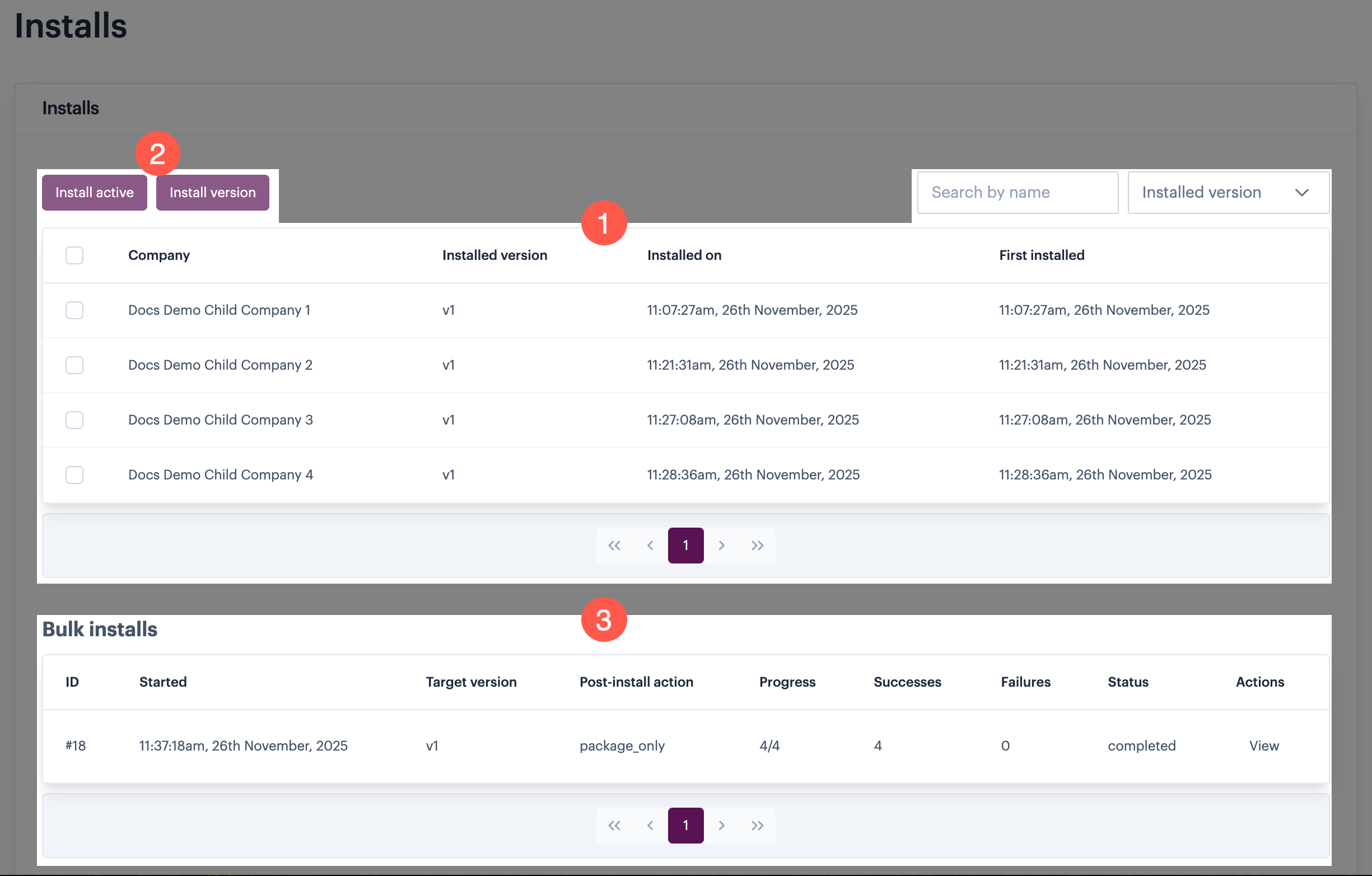
The installs page has three key areas: [**(1)** installs panel](#the-installs-panel); [**(2)** buttons for update actions](#update-actions); [bulk installs panel **(3)**](#the-bulk-installs-panel):

<figure><img src="/files/cUWtCqwrOeBWUnQJMLDf" alt=""><figcaption></figcaption></figure>

### The installs panel

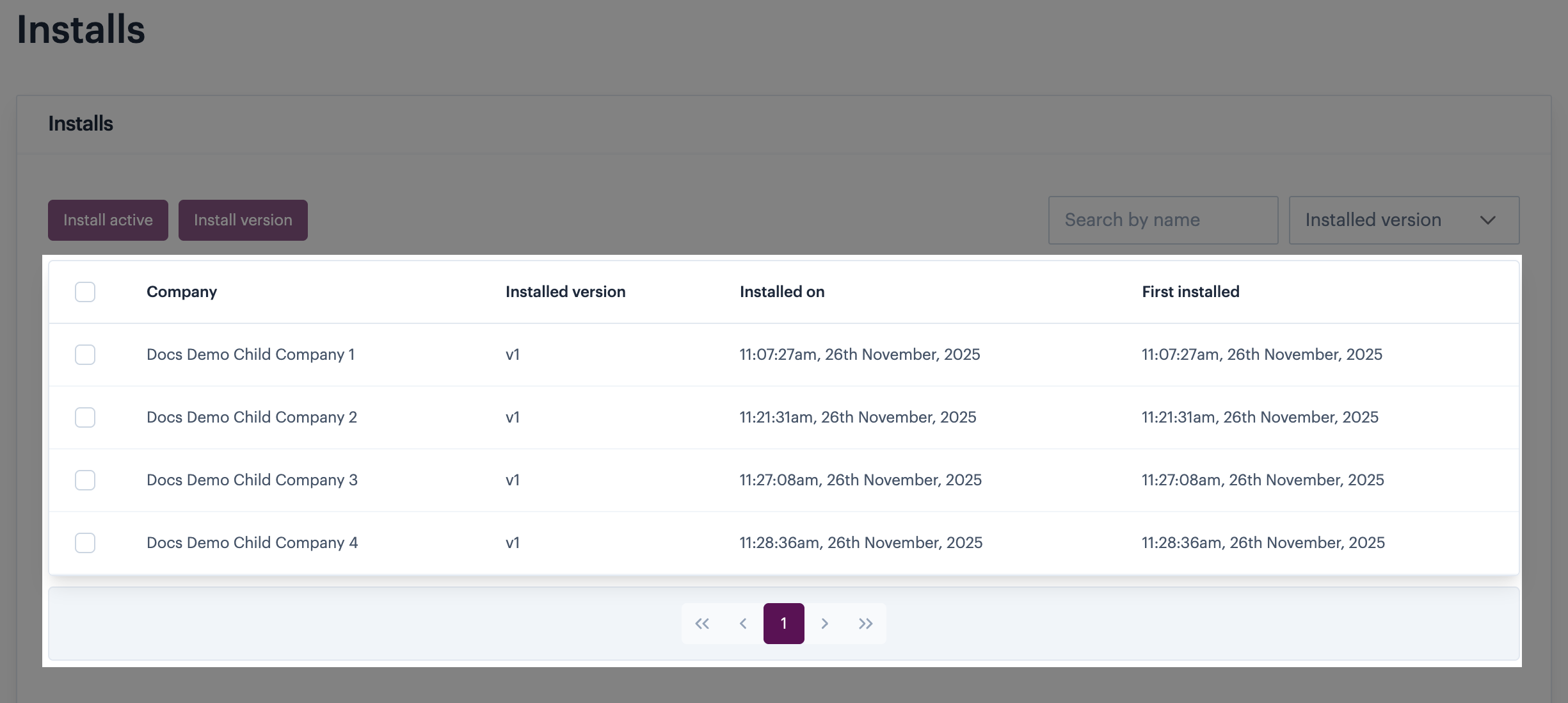
The `installs` panel lists all 'child' company profiles where any version of this blueprint is installed. For example:

<figure><img src="/files/XwCSMHq0S7lA96Vvu1Tb" alt=""><figcaption></figcaption></figure>

{% hint style="info" %}
If the blueprint is installed for your own company profile, this is also shown.&#x20;
{% endhint %}

The following details are displayed for each installation:

<table><thead><tr><th width="264.36328125">Column</th><th>Summary</th></tr></thead><tbody><tr><td>Company</td><td>The name of the company where this blueprint is installed.</td></tr><tr><td>Installed version</td><td>The currently installed version.</td></tr><tr><td>Installed on</td><td>The date and time the currently installed version was installed.</td></tr><tr><td>First installed</td><td>The date and time this blueprint was first installed.</td></tr></tbody></table>

#### Search & filter options

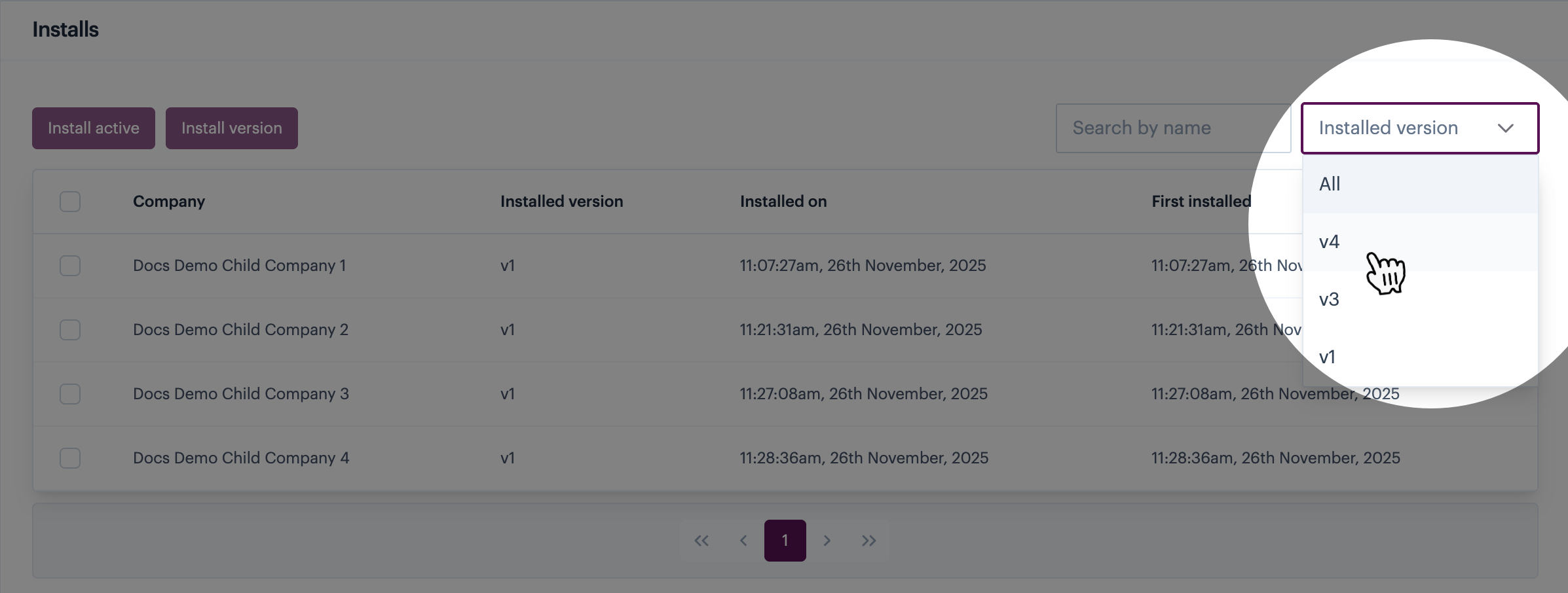
Over time, your list of installations will grow. If necessary, you can use the `search` field to find the installation for a particular company name (or partial company name). You can also filter the list of installations by a selected version.

{% columns %}
{% column %}
**Search**

<figure><img src="/files/99hgP7NkwgEvEnLBl5Gm" alt=""><figcaption></figcaption></figure>
{% endcolumn %}

{% column %}
**Filter**

<figure><img src="/files/Ju2uXD08hjaispWYUMVz" alt=""><figcaption></figcaption></figure>
{% endcolumn %}
{% endcolumns %}

### Update actions

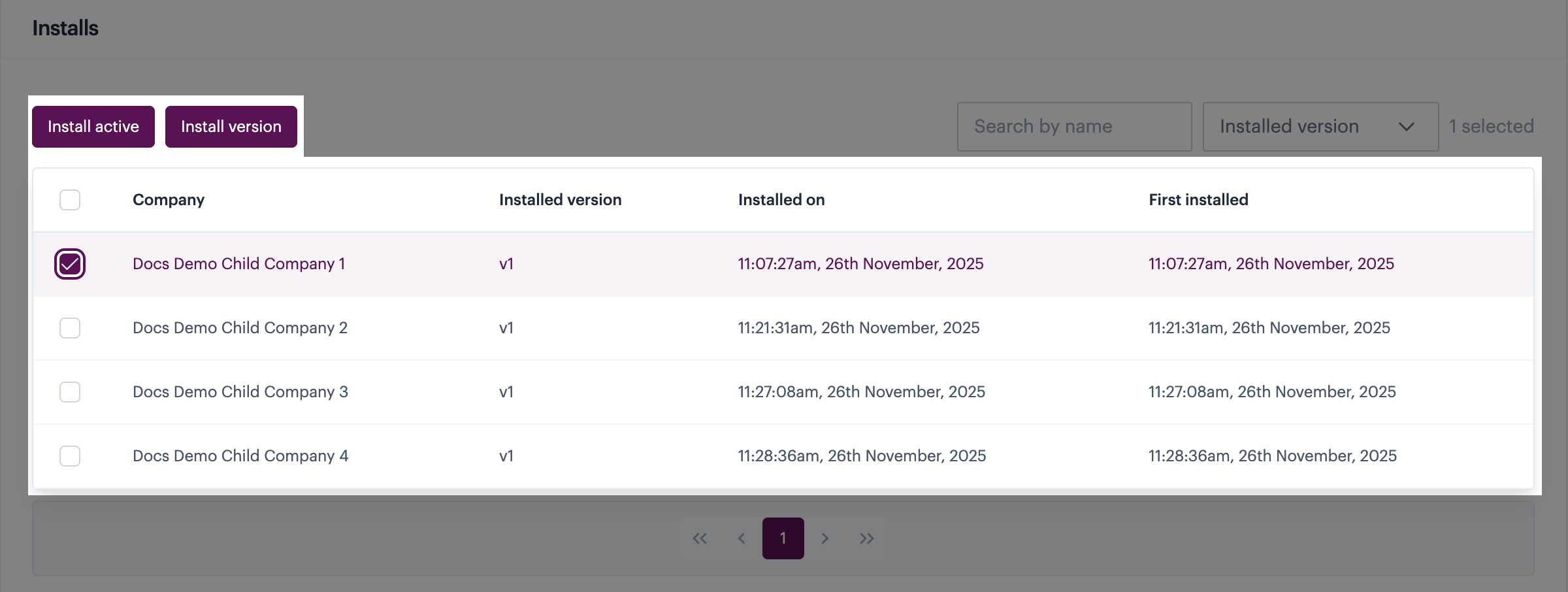
When at least one installation is selected, buttons above the [installs list](#the-installs-panel) become active. For example:

<figure><img src="/files/A5nCpwPWq0RnUOM9sVxW" alt=""><figcaption></figcaption></figure>

You can choose to:

* Promote the current [active version](/product-documentation/blueprints/working-with-private-blueprints/changing-the-active-version-for-a-private-blueprint.md) of this blueprint to the selected installation.&#x20;
* Promote/demote the selected installation to a specific version

Please refer to [Bulk blueprint updates (force)](/product-documentation/blueprints/working-with-private-blueprints/rolling-out-blueprint-updates/bulk-blueprint-updates-force.md) for further information on these actions.

### The bulk installs panel

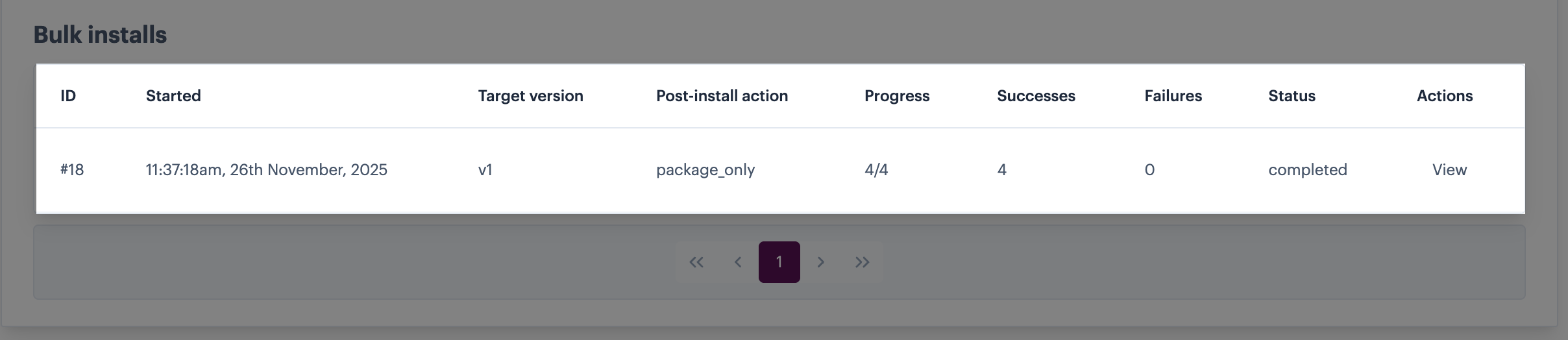
The `bulk installs` panel lists all 'bulk' updates that have taken place - i.e. all updates triggered using [update actions](#update-actions) on this page. For example:   &#x20;

<figure><img src="/files/JzyVbsmRB7tIsRpx2TY6" alt=""><figcaption></figcaption></figure>

Bearing in mind that a single bulk update can include updates to multiple installations, the following details are displayed for each bulk update:

<table><thead><tr><th width="264.36328125">Column</th><th>Summary</th></tr></thead><tbody><tr><td>ID</td><td>The unique identifier associated with this bulk update.</td></tr><tr><td>Started</td><td>When a bulk update is triggered, the job is queued for processing. The <code>started</code> time is the time that the job is queued.  </td></tr><tr><td>Target version</td><td>The version to be applied in this bulk update. </td></tr><tr><td>Post-install action</td><td>The action selected when the <a href="/pages/7QGh7jskTxwHP83Y1SXW">bulk update was triggered</a>. Will be set to: <code>none</code>, <code>package_only</code>, or <code>package_and_redeploy</code>.</td></tr><tr><td>Progress</td><td>The number of selected installations updated in relation  to the total number selected for the bulk update.</td></tr><tr><td>Successes</td><td>The number of installations updated successfully from this bulk update.   </td></tr><tr><td>Failures</td><td>The number of installations that failed during this bulk update.</td></tr><tr><td>Status</td><td>The current status of the bulk update. Will be set to <code>running</code>, <code>completed</code>, or <code>failed</code>.</td></tr><tr><td>Actions</td><td>Click the <code>view</code> option for installation details, including target company profiles and the status for each one. For more information, please refer to the <a href="#installation-details">Installation details</a> section below.</td></tr></tbody></table>

## Installation details

The `bulk installs` panel shows one entry for each bulk update however, you can use the `view` action to drill down for detailed information for each entry:

<div align="left"><figure><img src="/files/ZCddv6c3awt3Sk4ouVW7" alt=""><figcaption></figcaption></figure></div>

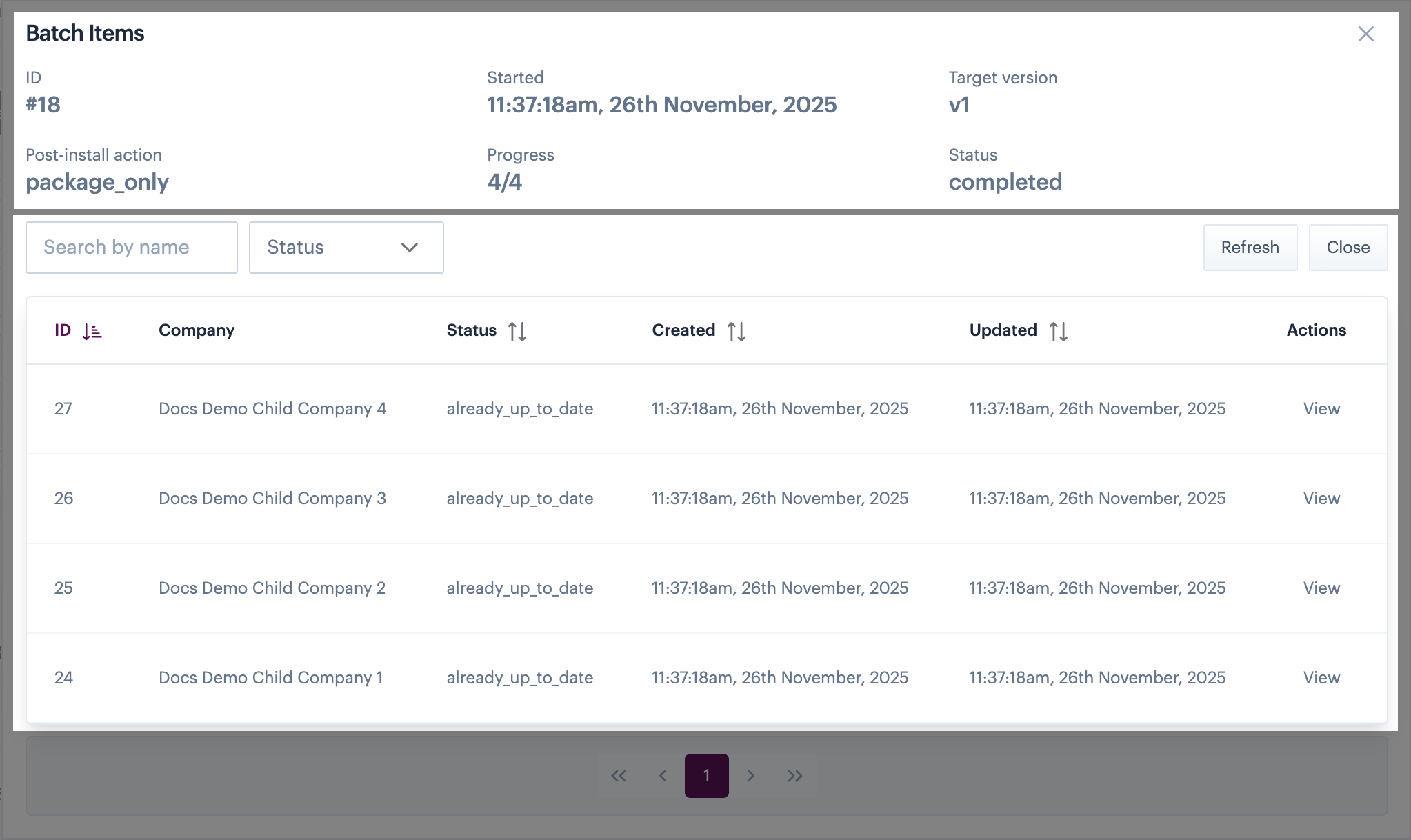
From here, the `batch items` page shows [general details](#batch-items-general-details) for the update, followed by a [breakdown of all company profiles included in this update](#batch-items-update-breakdown) (with the option to drill down for more information). For example:

<div align="left"><figure><img src="/files/LUxzTTbuyoP1Xy4y2gd4" alt=""><figcaption></figcaption></figure></div>

This information is especially useful if you need to investigate why a bulk update (or part of one) has failed.&#x20;

{% hint style="info" %}
If updates are pending, a `cancel` option (not shown in this screenshot) is available. For more information, see [Cancelling pending updates](#cancelling-pending-updates).
{% endhint %}

### Batch items - general details

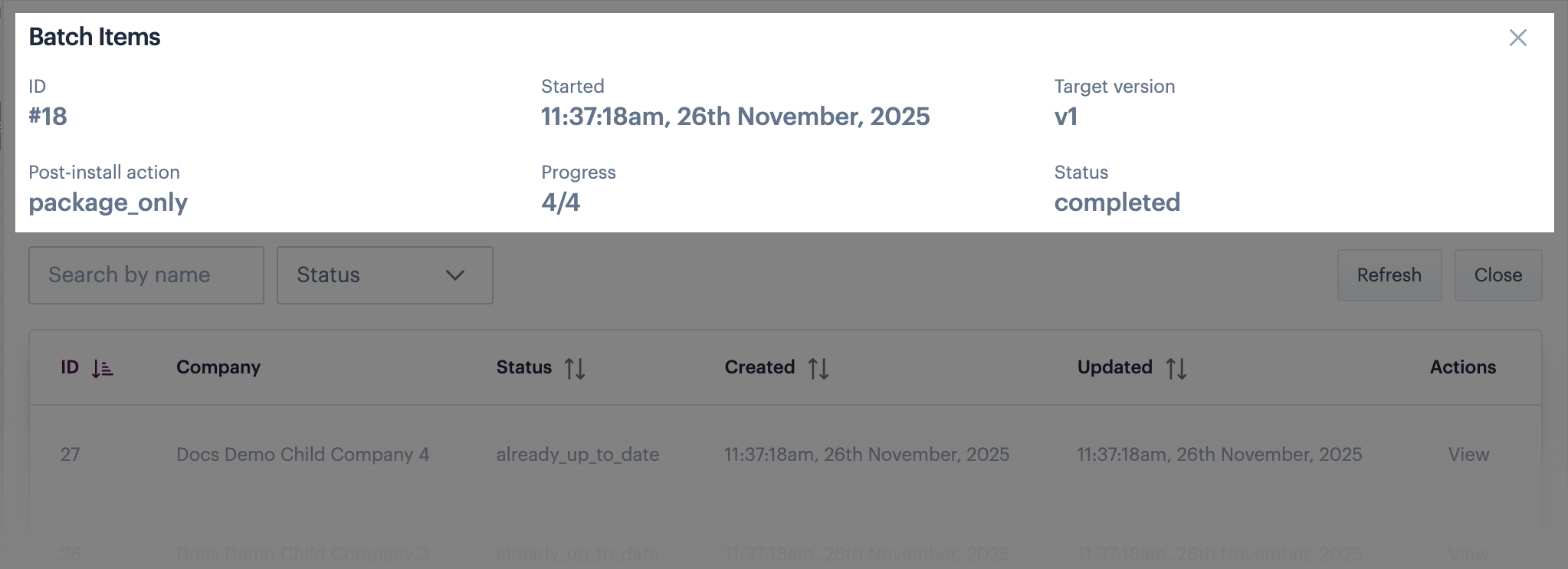
General details for the associated bulk update are shown in the top panel - for example:

<figure><img src="/files/TK9gD79RCm0P9Xz5UqFX" alt=""><figcaption></figcaption></figure>

Available details are summarised below:

<table><thead><tr><th width="264.71484375">Item</th><th>Summary</th></tr></thead><tbody><tr><td>ID</td><td>The unique ID for the associated bulk update. </td></tr><tr><td>Started</td><td>When a bulk update is triggered, the job is queued for processing. The <code>started</code> time is the time that the job is queued. </td></tr><tr><td>Target version</td><td>The version to be applied in this bulk update. </td></tr><tr><td>Post-install action</td><td>The action selected when the <a href="/pages/7QGh7jskTxwHP83Y1SXW">bulk update was triggered</a>. Will be set to: <code>none</code>, <code>package_only</code>, or <code>package_and_redeploy</code>.</td></tr><tr><td>Progress</td><td>Each installation (i.e. company) selected for a bulk update is an update in itself - so if you selected 4 installations to update, there will be 4 updates to complete. You'll see the number completed in the context of the total, here. </td></tr><tr><td>Status</td><td>The current status of the bulk update. Will be set to <code>running</code>, <code>completed</code>, or <code>failed</code>.</td></tr></tbody></table>

### Batch items - update breakdown

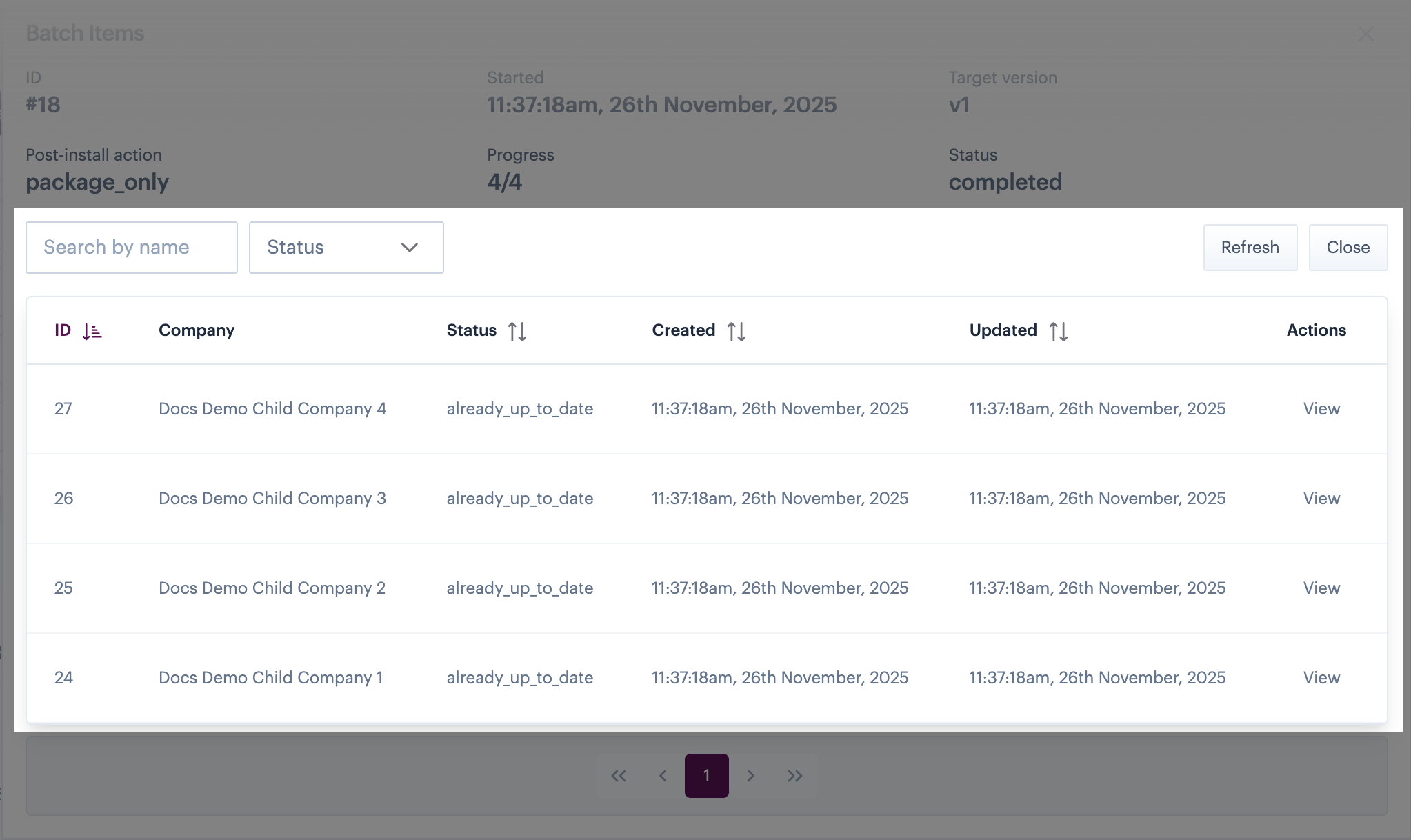
In the lower panel, you'll find one entry for each installation/company profile selected for inclusion in the bulk update - for example:

<figure><img src="/files/0M4rWGr28VTfTiBUXmy9" alt=""><figcaption></figcaption></figure>

Available options at the top of the breakdown pane are summarised below:

<table><thead><tr><th width="264.71484375">Item</th><th>Summary</th></tr></thead><tbody><tr><td>Search by name</td><td>Search for a specific installation/company by name or partial name (the search is not case sensitive).</td></tr><tr><td>Status filter</td><td>Use the dropdown list to filter the list of updates by current status.</td></tr><tr><td>Refresh</td><td>If a bulk update is running, information in this panel may change. Use the refresh button to update this page (including the <a href="#batch-items-general-details">general details pane</a>).</td></tr><tr><td>Close</td><td>Close this page and exit back to the main <a href="#understanding-the-installs-page">installs page</a>.</td></tr></tbody></table>

Available details for each installation/company are summarised below:

<table><thead><tr><th width="264.71484375">Item</th><th>Summary</th></tr></thead><tbody><tr><td>ID</td><td>The unique ID for the specific update.</td></tr><tr><td>Company</td><td>The company profile selected for update.</td></tr><tr><td>Status</td><td><p>When a bulk update runs, each specific update has its own status. This will be set to one of the following values:</p><ul><li><code>pending</code> (update has not started)</li><li><code>processing</code> (update is in progress)</li><li><code>installed</code> (update completed successfully)</li><li><code>already_up_to_date</code> (the version selected for installation was found to be installed already)</li><li><code>cancelled</code> (the <a href="#cancelling-pending-updates">user cancelled this update</a> when it was pending)</li></ul></td></tr><tr><td>Created</td><td> The date and time that the bulk update was triggered.</td></tr><tr><td>Updated</td><td> The last time this specific installation was updated.</td></tr><tr><td>Actions</td><td><p>Click the <code>view</code> option to view more details (including any error messages) for the associated update. For example:</p><p></p><p><img src="/files/945NbkjQR6fdGbU3qntc" alt=""></p><p></p><p>Errors are unlikely, but if they do occur, the most likely cause is a configuration anomaly.  </p></td></tr></tbody></table>

{% hint style="info" %}
If updates are pending, a `cancel` option (not shown in this screenshot) is available. For more information, see [Cancelling pending updates](#cancelling-pending-updates).
{% endhint %}

### Cancelling pending updates

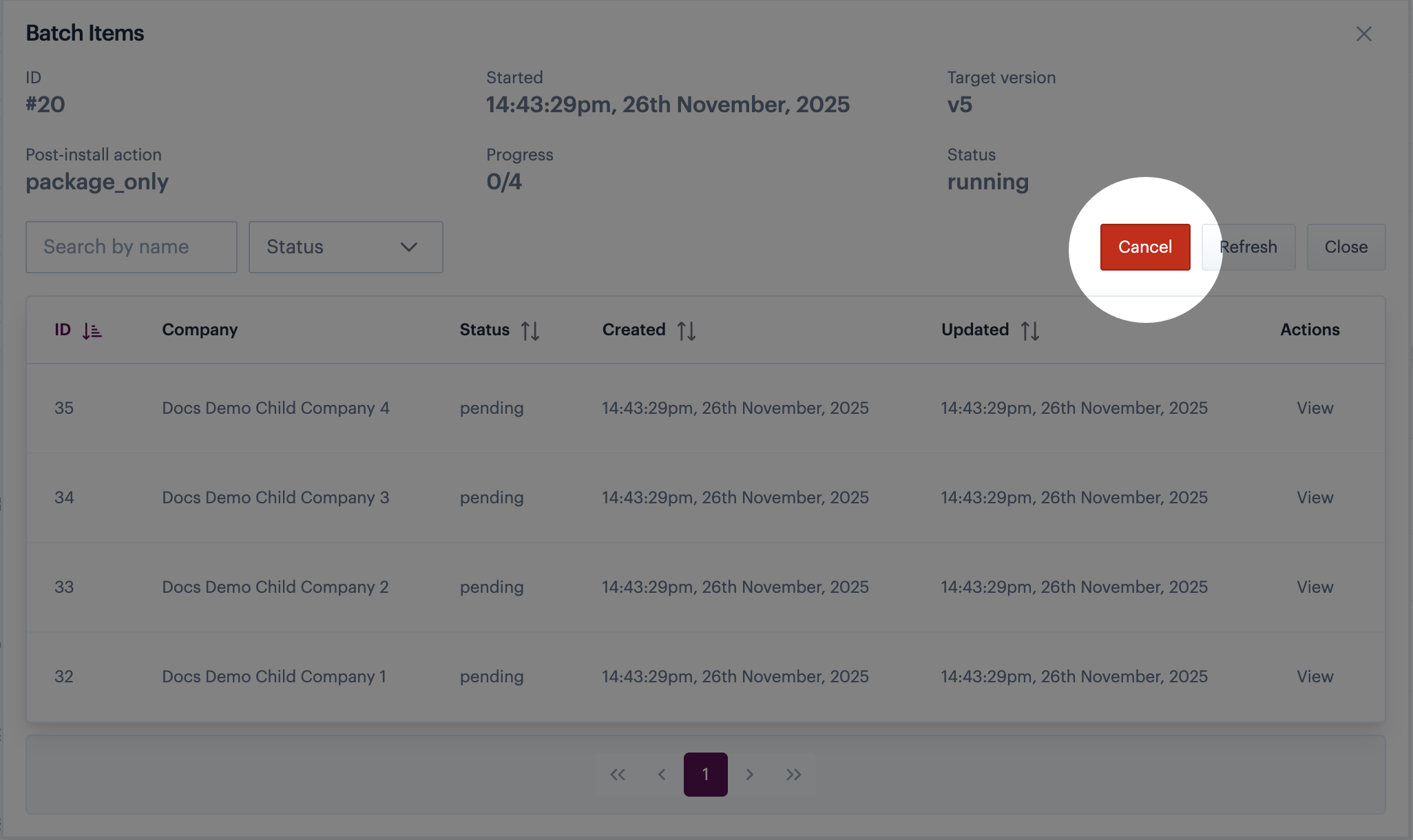
If you view details for a bulk install and the update is still running, you can choose to cancel any `pending` installations using the `cancel` button. For example: &#x20;

<figure><img src="/files/8buGi2AOecmkvdjXQ4wp" alt=""><figcaption></figcaption></figure>

Any `pending` jobs will be cancelled. Any jobs that are currently set to a `processing` status will not be cancelled.&#x20;


---

# Agent Instructions: Querying This Documentation

If you need additional information that is not directly available in this page, you can query the documentation dynamically by asking a question.

Perform an HTTP GET request on the current page URL with the `ask` query parameter:

```
GET https://doc.wearepatchworks.com/product-documentation/blueprints/working-with-private-blueprints/rolling-out-blueprint-updates/viewing-current-blueprint-installations.md?ask=<question>
```

The question should be specific, self-contained, and written in natural language.
The response will contain a direct answer to the question and relevant excerpts and sources from the documentation.

Use this mechanism when the answer is not explicitly present in the current page, you need clarification or additional context, or you want to retrieve related documentation sections.