 Click to view process flow snapshot
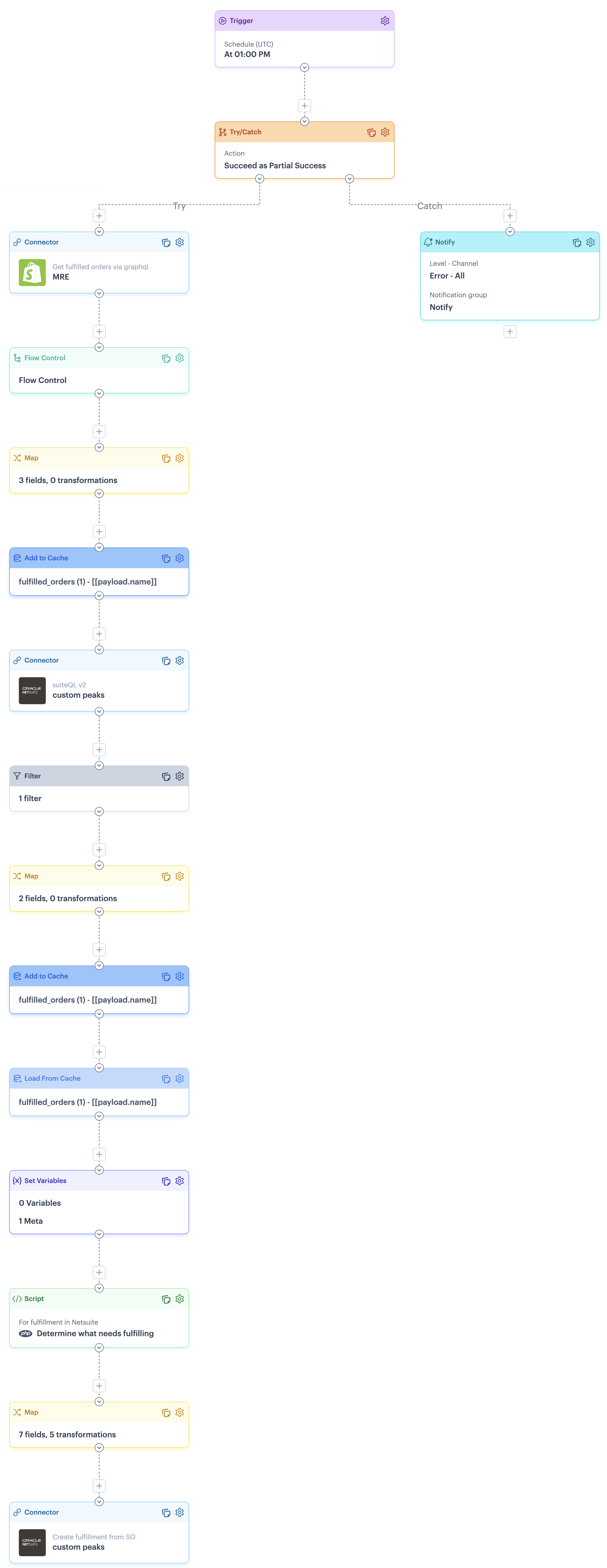 Click to view process flow snapshot
| Limitation | Summary |
|---|---|
| Carrier information in NetSuite. | Out of the box, NetSuite does not include a 'carrier' field in the package section of item fulfillments. |
| Shopify GraphQL error handling | There is a known limitation with error handling for Shopify GraphQL. Please refer to the Error handling for Shopify GraphQL section for more information and a suggested approach that you may wish to adopt in your flows. |
| Flow variable | Summary | Default value |
|---|---|---|
datefrom | Set the relative time period to look back for new fulfillments in Shopify. The default setting is for a long lookback period, but you can update this value as required. | -10 days |
| Shape | Notes |
|---|---|
| Trigger | This GraphQL query on the Shopify connector retrieves fulfillments/partial fulfillments that have been created since your given lookback period (based on the value of the datefrom flow variable). You should ensure that the trigger schedule aligns with your lookback period, or run this flow manually. |
| Notify | This flow is designed in a try/catch structure, so notifications are generated if any part of the flow fails. To achieve this, the catch route includes a notify shape, which must be configured for your own notification preferences.Alert level: Defaults to error but can be changed if neededChannel: Defaults to email + log but can be changed if neededEmail Limit: Defaults to 5 but can be changed if neededNotification Group: Replace the notify placeholder which your required notification group.Message: If required, you can change the placeholder message.For more information, please refer to our Notify shape and Notification groups pages. |
| Connector (Shopify) | If you did not add or select a Shopify instance during the blueprint installation process, the following settings must be configured:Source instance : Set to your required Shopify instance.Source endpoint : Set to POST Get fulfilled orders via graphqlVariables : Leave the Filter variable as it defaults. |
| Connector (NetSuite) | If you did not add or select a NetSuite instance during the blueprint installation process, the following settings must be configured:
|
| Connector (NetSuite) | If you did not add or select a NetSuite instance during the blueprint installation process, the following settings must be configured:
|
| Script | Summary |
|---|---|
| Determine what needs fulfilling | Checks the SKUs from Shopify to match the fulfillment lines needed for Netsuite. |