> For the complete documentation index, see [llms.txt](https://doc.wearepatchworks.com/product-documentation/llms.txt). Markdown versions of documentation pages are available by appending `.md` to page URLs; this page is available as [Markdown](https://doc.wearepatchworks.com/product-documentation/patchworks-services/inbound-api/using-the-inbound-api-connector-with-patchworks-services/adding-a-patchworks-service-for-an-inbound-api-connector/add-a-default-service.md).
# Add a default service
## Introduction
This page is **part 1** of of the instruction set for [adding a Patchworks service for an Inbound API connector](/product-documentation/patchworks-services/inbound-api/using-the-inbound-api-connector-with-patchworks-services/adding-a-patchworks-service-for-an-inbound-api-connector.md):
| Part # | Link to instructions |
| ------ | ------------------------------------------------------------------------------------------------------------------------------------------------------------------------------------------------------------------------------------------------ |
| **1** | **Add a default service** |
| 2 | [Configure service settings](/product-documentation/patchworks-services/inbound-api/using-the-inbound-api-connector-with-patchworks-services/adding-a-patchworks-service-for-an-inbound-api-connector/configure-service-settings.md) |
| 3 | [Set the service trigger schedule](/product-documentation/patchworks-services/inbound-api/using-the-inbound-api-connector-with-patchworks-services/adding-a-patchworks-service-for-an-inbound-api-connector/set-the-service-trigger-schedule.md) |
| 4 | [Define field mappings](/product-documentation/patchworks-services/inbound-api/using-the-inbound-api-connector-with-patchworks-services/adding-a-patchworks-service-for-an-inbound-api-connector/define-field-mappings.md) |
| 5 | [Activate the service](/product-documentation/patchworks-services/inbound-api/using-the-inbound-api-connector-with-patchworks-services/adding-a-patchworks-service-for-an-inbound-api-connector/activate-the-service.md) |
## The steps
Follow the steps below to add a default service.
**Step 1** \
Select **services** from the left-hand navigation menu:

**Step 2** \
Click the **add new service** button:

This option is also available from the bottom of any connector setup page, so if you’ve just finished [adding an Inbound API connector](/product-documentation/patchworks-services/inbound-api/using-the-inbound-api-connector-with-patchworks-services/adding-an-inbound-api-connector-with-a-custom-payload.md), you can go straight to service setup from there:

When you add a new service from a connector, this connector becomes the **source** automatically.
**Step 3** \
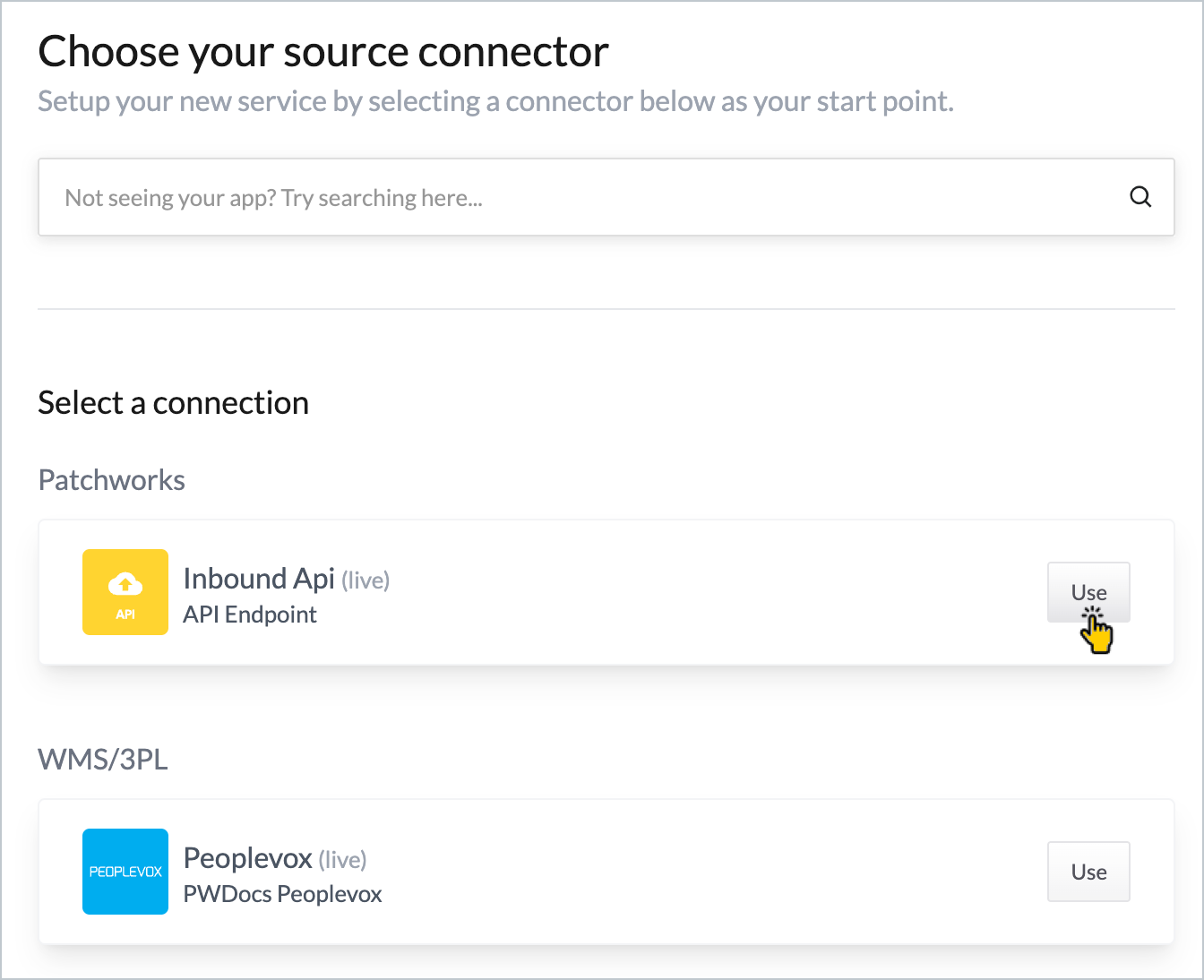
When prompted to choose a **source connector** (all configured connectors for your implementation are listed), select the **Inbound API** connector:
**Step 4**\
When prompted to choose a **destination connector**, select the connector that you want to receive incoming data from the API connector:

{% hint style="info" %}
All configured connectors - excluding the one already selected for the **source** (i.e. the Inbound API connector) - are available for selection.
{% endhint %}
**Step 5**\
The **configure service settings** page is displayed - please see [configure service settings](/product-documentation/patchworks-services/inbound-api/using-the-inbound-api-connector-with-patchworks-services/adding-a-patchworks-service-for-an-inbound-api-connector/configure-service-settings.md) for guidance.