> For the complete documentation index, see [llms.txt](https://doc.wearepatchworks.com/product-documentation/llms.txt). Markdown versions of documentation pages are available by appending `.md` to page URLs; this page is available as [Markdown](https://doc.wearepatchworks.com/product-documentation/patchworks-services/working-with-services/field-mappings-and-transformations-services/legacy-shipment-and-payment-maps-services.md).

# Legacy shipment & payment maps (services)

## Introduction

In older versions of the Patchworks dashboard, shipment and payment mappings for services are defined via [Company Groups](broken://pages/jZdqx8MTOZe4Ht1XQiGc).

{% hint style="info" %}
In the latest version, [mappings are defined for each service](/product-documentation/patchworks-services/working-with-services/field-mappings-and-transformations-services/field-mappings-services.md).
{% endhint %}

This page summarises how to access and update shipment/payment mappings if you are not using the latest version of the Patchworks dashboard.

## Accessing Shipment and Payment Maps&#x20;

Follow the steps below:\
\
**Step 1**\
Log in to the *Patchworks dashboard*.

**Step 2**\
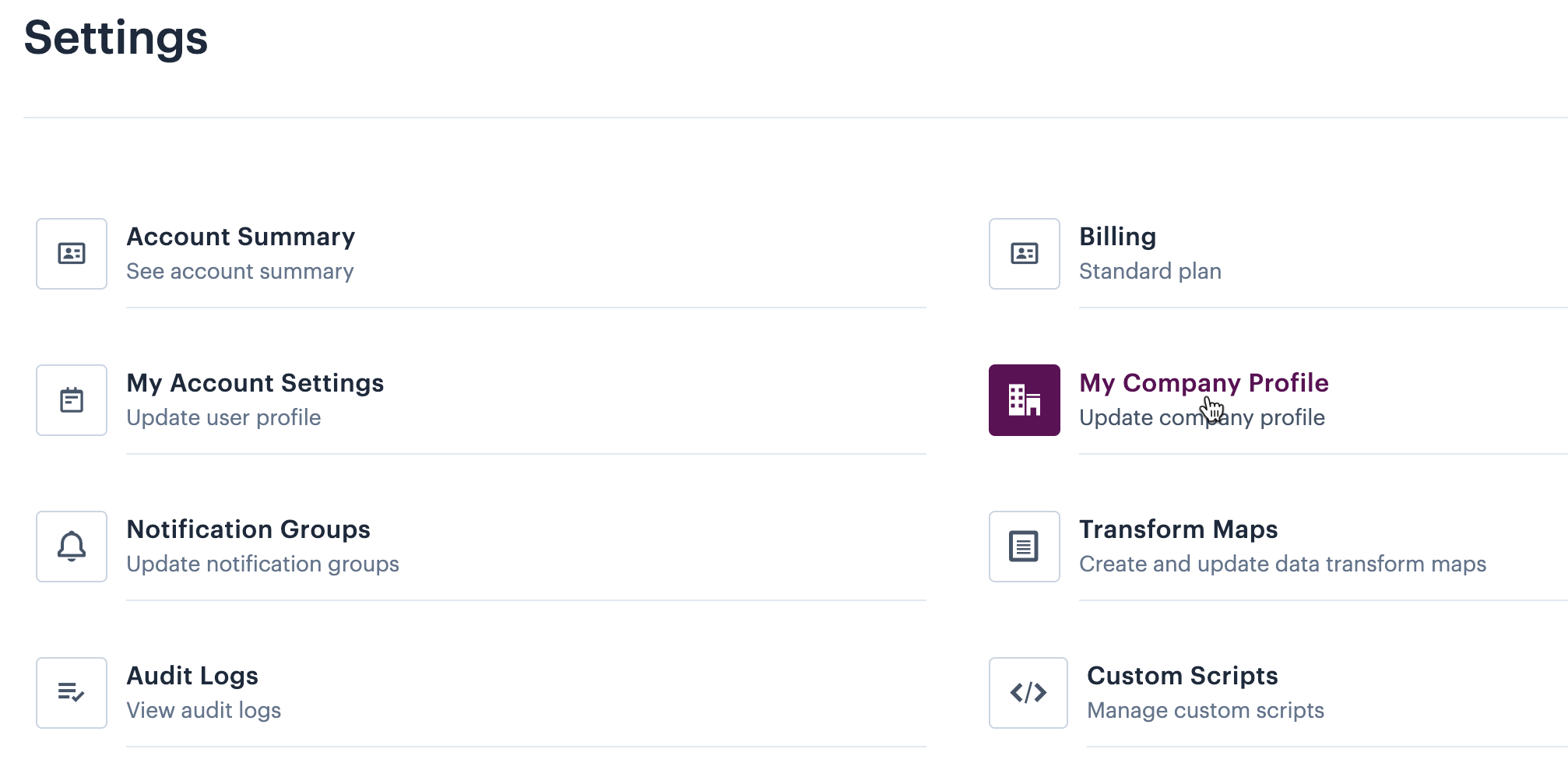
Move to the bottom of the left-hand navigation bar and select *Settings*:&#x20;

![](/files/7h9cejdJpynAbdSDawPZ)

**Step 3**\
Select **my company profile**:

<figure><img src="/files/N1OX7yRAhR0oPpjUshhU" alt=""><figcaption></figcaption></figure>

**Step 4**\
Scroll down to the *Company Groups* section and click the *Manage* option for the required group - for example:

![](/files/1gPLInj9CDR6gEvTDZju)

**Step 5**\
Scroll to the *Shipment and Payment Maps* section at the end of the *Manage Company Group* page:

![](/files/n7kbShwn1gQ56lHICfS2)

**Step 6**\
Select the *Manage Shipment Map* or *Manage Payment Map* option, as required.

## Working with Shipment and Payment Maps&#x20;

*Shipment Data Mapping* and *Payment Data Mapping* pages work in the same way.&#x20;

In each case, you map the value of a field to a different output value based on given conditions. Some examples are shown below:

![](/files/LbX1jRbn01kwy7jtN1ih)

Each mapping is added as a row, where the following elements are defined:

<table><thead><tr><th>Mapping Element</th><th>Summary</th><th data-hidden></th></tr></thead><tbody><tr><td>Field Name</td><td>Enter the name of a source field to be transformed.</td><td></td></tr><tr><td>Match Value</td><td>Select the condition under which the given <em>Field Name</em> should be transformed. Possible match values are:<br>- Contains<br>- Starts With<br>- Ends With<br>- Exact</td><td></td></tr><tr><td>Match Type</td><td>Enter the value to be matched if found in the <em>Field Name</em>.</td><td></td></tr><tr><td>Output Value</td><td>Enter the value to be output when a match is made.</td><td></td></tr></tbody></table>

### Adding a new mapping entry

To add a new mapping entry, scroll to the end of the page and select *Add field*:

![](/files/JfwExe594sZnYvgb6Vif)

A new row is added to the list, ready for you to complete:

![](/files/mhpTOgAQSp7Mg5jQNGtv)

Update each element for the mapping, then click the *Update* button at the bottom of the page to apply changes.

### Deleting an existing mapping entry

To delete an existing mapping entry, click the minus symbol associated with the row to be removed - for example:

![](/files/BjEoZyrWCbkFFhenqWW4)

The row is removed immediately - click the *Update* button at the bottom of the page to apply changes.
