# Legacy shipment & payment maps (services)

## Introduction

In older versions of the Patchworks dashboard, shipment and payment mappings for services are defined via [Company Groups](https://doc.wearepatchworks.com/product-documentation/patchworks-services/working-with-services/field-mappings-and-transformations-services/broken-reference).

{% hint style="info" %}
In the latest version, [mappings are defined for each service](https://doc.wearepatchworks.com/product-documentation/patchworks-services/working-with-services/field-mappings-and-transformations-services/field-mappings-services).
{% endhint %}

This page summarises how to access and update shipment/payment mappings if you are not using the latest version of the Patchworks dashboard.

## Accessing Shipment and Payment Maps&#x20;

Follow the steps below:\
\
**Step 1**\
Log in to the *Patchworks dashboard*.

**Step 2**\
Move to the bottom of the left-hand navigation bar and select *Settings*:&#x20;

![](https://content.gitbook.com/content/5mpqoXPMbUuPa8JpCLWe/blobs/7CeoOF14fGVthB0d4YXn/select%20settings%20option.png)

**Step 3**\
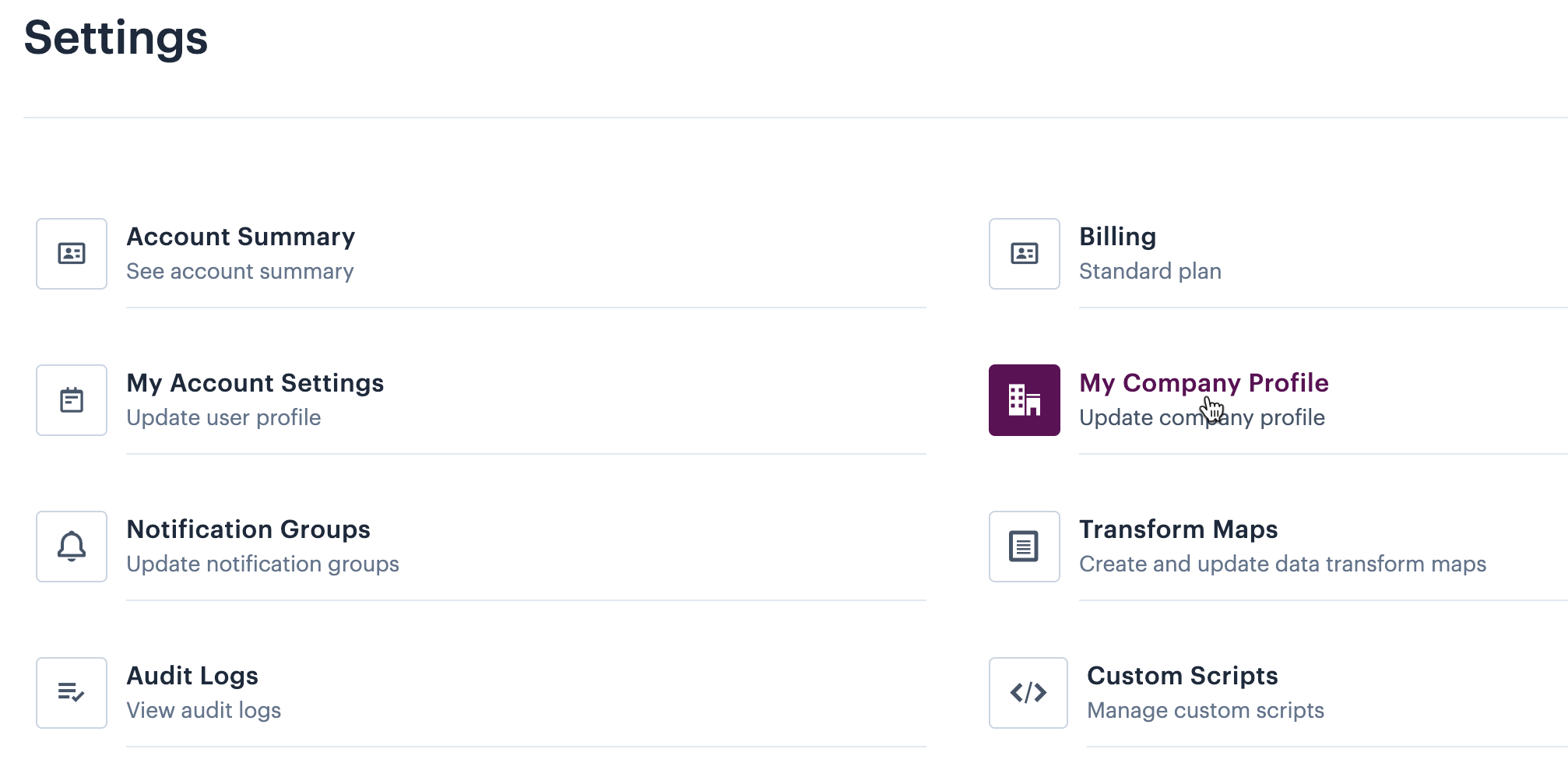
Select **my company profile**:

<figure><img src="https://content.gitbook.com/content/5mpqoXPMbUuPa8JpCLWe/blobs/NzmERzWwogjxW3P4Aduq/my%20company%20profile%201.png" alt=""><figcaption></figcaption></figure>

**Step 4**\
Scroll down to the *Company Groups* section and click the *Manage* option for the required group - for example:

![](https://content.gitbook.com/content/5mpqoXPMbUuPa8JpCLWe/blobs/TCCKqYAkCW4np9BwlHA6/manage%20group%20selected.png)

**Step 5**\
Scroll to the *Shipment and Payment Maps* section at the end of the *Manage Company Group* page:

![](https://content.gitbook.com/content/5mpqoXPMbUuPa8JpCLWe/blobs/6GQA6zJWiZoSFRK6O6ZB/manage%20shipment%20and%20payments.png)

**Step 6**\
Select the *Manage Shipment Map* or *Manage Payment Map* option, as required.

## Working with Shipment and Payment Maps&#x20;

*Shipment Data Mapping* and *Payment Data Mapping* pages work in the same way.&#x20;

In each case, you map the value of a field to a different output value based on given conditions. Some examples are shown below:

![](https://content.gitbook.com/content/5mpqoXPMbUuPa8JpCLWe/blobs/Fi14jSDBT1sd4Y3VKXAK/shipment%20data%20mapping%20page.png)

Each mapping is added as a row, where the following elements are defined:

<table><thead><tr><th>Mapping Element</th><th>Summary</th><th data-hidden></th></tr></thead><tbody><tr><td>Field Name</td><td>Enter the name of a source field to be transformed.</td><td></td></tr><tr><td>Match Value</td><td>Select the condition under which the given <em>Field Name</em> should be transformed. Possible match values are:<br>- Contains<br>- Starts With<br>- Ends With<br>- Exact</td><td></td></tr><tr><td>Match Type</td><td>Enter the value to be matched if found in the <em>Field Name</em>.</td><td></td></tr><tr><td>Output Value</td><td>Enter the value to be output when a match is made.</td><td></td></tr></tbody></table>

### Adding a new mapping entry

To add a new mapping entry, scroll to the end of the page and select *Add field*:

![](https://content.gitbook.com/content/5mpqoXPMbUuPa8JpCLWe/blobs/17jRg5z2qEfad49TOrOs/shipment%20data%20mapping%20page%20-%20add%20field.png)

A new row is added to the list, ready for you to complete:

![](https://content.gitbook.com/content/5mpqoXPMbUuPa8JpCLWe/blobs/EcyiJBF8Bh6fLA9bVsBj/new%20mapping%20row%20added.png)

Update each element for the mapping, then click the *Update* button at the bottom of the page to apply changes.

### Deleting an existing mapping entry

To delete an existing mapping entry, click the minus symbol associated with the row to be removed - for example:

![](https://content.gitbook.com/content/5mpqoXPMbUuPa8JpCLWe/blobs/LtIDJ0Y3VmCuChq6CnJE/shipment%20data%20mapping%20page%20-%20delete%20field.png)

The row is removed immediately - click the *Update* button at the bottom of the page to apply changes.


---

# Agent Instructions: Querying This Documentation

If you need additional information that is not directly available in this page, you can query the documentation dynamically by asking a question.

Perform an HTTP GET request on the current page URL with the `ask` query parameter:

```
GET https://doc.wearepatchworks.com/product-documentation/patchworks-services/working-with-services/field-mappings-and-transformations-services/legacy-shipment-and-payment-maps-services.md?ask=<question>
```

The question should be specific, self-contained, and written in natural language.
The response will contain a direct answer to the question and relevant excerpts and sources from the documentation.

Use this mechanism when the answer is not explicitly present in the current page, you need clarification or additional context, or you want to retrieve related documentation sections.
