# Company insights overview

## Introduction

The `company insights` page is designed to help you understand how your process flows are performing, and resource usage. At a glance, you can see which process flows are most heavy on resources, drilling down to performance for connectors and shapes that are included within those process flows:&#x20;

## Need to know

Company insights data is loaded at 1 a.m. every morning. This means that data for the current day will not be fully populated until 1 a.m. the following day.

## Understanding the company insights page

Key areas to consider on the `company insights` page are marked below:

<div align="left"><figure><img src="/files/y8Q9DcOBeRFZVnMuRanC" alt=""><figcaption></figcaption></figure></div>

These areas are summarised below:

<table><thead><tr><th width="153">Item</th><th>Summary</th></tr></thead><tbody><tr><td>1</td><td><strong>Subscription information</strong><br>Your Patchworks subscription is displayed as a button - click this to view your allowances, with access to more information on subscription tiers:<br><br><img src="/files/fgo1M6ZtYPjw6mDGSBva" alt="" data-size="original"><br><br>Allowances shown are for the current company profile. If you operate under an 'annual billing' agreement, the allowances shown here will be those available for the current company profile, multiplied by 12.</td></tr><tr><td>2</td><td><p><strong>Monthly usage date selector</strong></p><p>Choose a time period to analyse:<br><br><img src="/files/29KC5UbWq8zsELCnrr6k" alt=""><br><br>All subsequent data displayed is for the selected period. The selection here also determines how analysis is shown on the <a href="#combination-chart">combination chart</a>.</p></td></tr><tr><td>3</td><td><a href="#managed-company-insights">Managed company selector.</a> <br>If you manage multiple company profiles, you'll see insights for your own (parent) company profile by default. You can also use this dropdown field to view aggregated insights for all your linked companies.</td></tr><tr><td>4</td><td><a href="#performance-snapshot-panel">Performance snapshot panel</a><br>At a glance, view your aggregated data and operations usage. These numbers are for the month, <a href="#data-selectors">data type</a>, and (if applicable) the <a href="#managed-company-insights">managed company option</a> currently selected.</td></tr><tr><td>5</td><td><p>Download the current summary as a CSV file. The CSV file is delimited with a single comma and includes the following fields:</p><pre><code>company,cpu_time,payload_size,operations_sent,operations_received
</code></pre></td></tr><tr><td>6</td><td><a href="#data-selectors">Data selectors</a><br>Choose the type of data be analysed (process flows, connectors, or shapes). </td></tr><tr><td>7</td><td><p><a href="#combination-chart">Combination chart</a></p><p>A visual representation of usage by day, for the month and <a href="#data-selectors">data type</a> currently selected. </p></td></tr><tr><td>8</td><td><p><a href="#data-breakdown-panel">Data breakdown</a></p><p>A breakdown of each process flow, connector, or shape (depending which data type is selected) that's included in aggregated totals for the selected month. </p></td></tr><tr><td>9</td><td><p><a href="#tracked-data-graph">Tracked data graph</a></p><p> A visual representation of tracked records (inbound or outbound) for a selected time period.</p></td></tr></tbody></table>

### Performance snapshot panel

The snapshot panel provides summary metrics for the overall performance of your company's process flows, connectors used in process flows, and shapes used in process flows, for the selected month.&#x20;

<div align="left"><figure><img src="/files/YHxm7edCCE8x5eqOZcWc" alt=""><figcaption></figcaption></figure></div>

These metrics are summarised below:

<table><thead><tr><th width="157">Metric</th><th>Summary</th></tr></thead><tbody><tr><td>Data usage</td><td>The aggregated size of all payloads that leave each shape in a process flow - these are known as <em>payloads out</em>. </td></tr><tr><td>Operation usage</td><td>The total number of operations completed. For more information about how operations are calculated please see <a href="/pages/HbzTGbVdtvNIdHpdRKBc">About operations</a>.</td></tr></tbody></table>

If you manage multiple company profiles, these totals will vary, depending on how the managed company selector is set. For more information, see [Managed company insights](#managed-company-insights).

{% hint style="info" %}
The `data usage` value shown here is the same as displayed in the left-hand navigation bar. If you notice a difference occasionally, this is most likely due to caching; values in the navigation bar are cached, but those on the main insights page are not. If this happens, you should work from the values shown on the insights page (caching will resolve itself in due course).
{% endhint %}

{% hint style="info" %}
If you operate under a 'powered by' agreement, usage bars will always show values associated with the parent company only, irrespective of whether the [managed company selector](#managed-company-insights) is set for `parent company`, `managed companies`, or `parent+managed companies`.
{% endhint %}

### Data type selectors

You can view insights for process flows, connectors used in process flows, and shapes used in process flows (for the selected month) - click the required selector tab for whichever of these you want to view:

<figure><img src="/files/Zl4TxwFMpRztGO1wBXhI" alt=""><figcaption></figcaption></figure>

Changing the selection here updates all metrics and analysis for the new data type.&#x20;

### Combination chart

The combination chart shows aggregated metrics for:

* Received operations
* Sent operations
* CPU hours
* Payload sizes

For example:

<figure><img src="/files/BaoQZUdVc158CRAuUKAz" alt=""><figcaption></figcaption></figure>

#### Chart display

Chart data is broken down differently, depending on how the [monthly usage date selector](#understanding-the-company-insights-page) is set at the top of the page:

<table data-card-size="large" data-view="cards"><thead><tr><th></th></tr></thead><tbody><tr><td><strong>By month</strong><br>Usage analysis is shown for each day within the selected month.<br><br><img src="/files/e5zRqL5pClgfaMKfUbbB" alt=""></td></tr><tr><td><strong>Last 12 months</strong><br>Usage analysis is shown for each month within the last 12 months.<br><br><img src="/files/e0XRE34GG4lFhoPdbcIr" alt=""></td></tr><tr><td><strong>Custom date (3 months or less)</strong><br>Usage analysis is shown for each day within the selected period.<br><br><img src="/files/6cPYRAuYCsLT6QdFLHTZ" alt=""></td></tr><tr><td><strong>Custom date (+3 months)</strong><br>Usage analysis is shown for each month within the selected period.<br><img src="/files/uMSPgUzzWCgZmFOo2NcG" alt=""></td></tr></tbody></table>

#### Chart interactions

You can interact with this chart in several ways:

<table data-view="cards"><thead><tr><th></th><th></th><th></th></tr></thead><tbody><tr><td>Hover your cursor over an option to bring the corresponding data into focus:</td><td><img src="/files/hyb9fHbXC8fKQVefWm2R" alt=""></td><td></td></tr><tr><td>Click an option to toggle the corresponding data on/off:</td><td><img src="/files/uKsxxT7OEIR8iolupJk5" alt=""></td><td></td></tr><tr><td>Hover your cursor over any data point to view summary information:</td><td><img src="/files/t2mLjUHNnYHvvutbLlNF" alt=""></td><td></td></tr></tbody></table>

### Data breakdown panel

Beneath the combination chart, you'll find a breakdown of items ([process flows](#process-flow-data), [connectors](#connector-data), or [shapes](#shape-data)) included in summary metrics.

#### Process flow data

When [process flow data is selected](#data-selectors), you'll see a list of process flows that have been run within the selected month:

<figure><img src="/files/0RH80UMlztvrLXLtgLVF" alt=""><figcaption></figcaption></figure>

For each entry, you can see the process flow name, CPU time used, the number of times used (i.e. run), data usage, and [operations usage](/product-documentation/company-management/company-insights/company-insights-overview/about-operations.md).&#x20;

#### Connector data

When [connector data is selected](#data-selectors), you'll see a list of connectors that have been used within the selected month:

<figure><img src="/files/e8cZWqLV1UmpfGAgZw6v" alt=""><figcaption></figcaption></figure>

For each entry, you can see the connector name, CPU time used, the number of times used, data usage, and [operations usage](/product-documentation/company-management/company-insights/company-insights-overview/about-operations.md).&#x20;

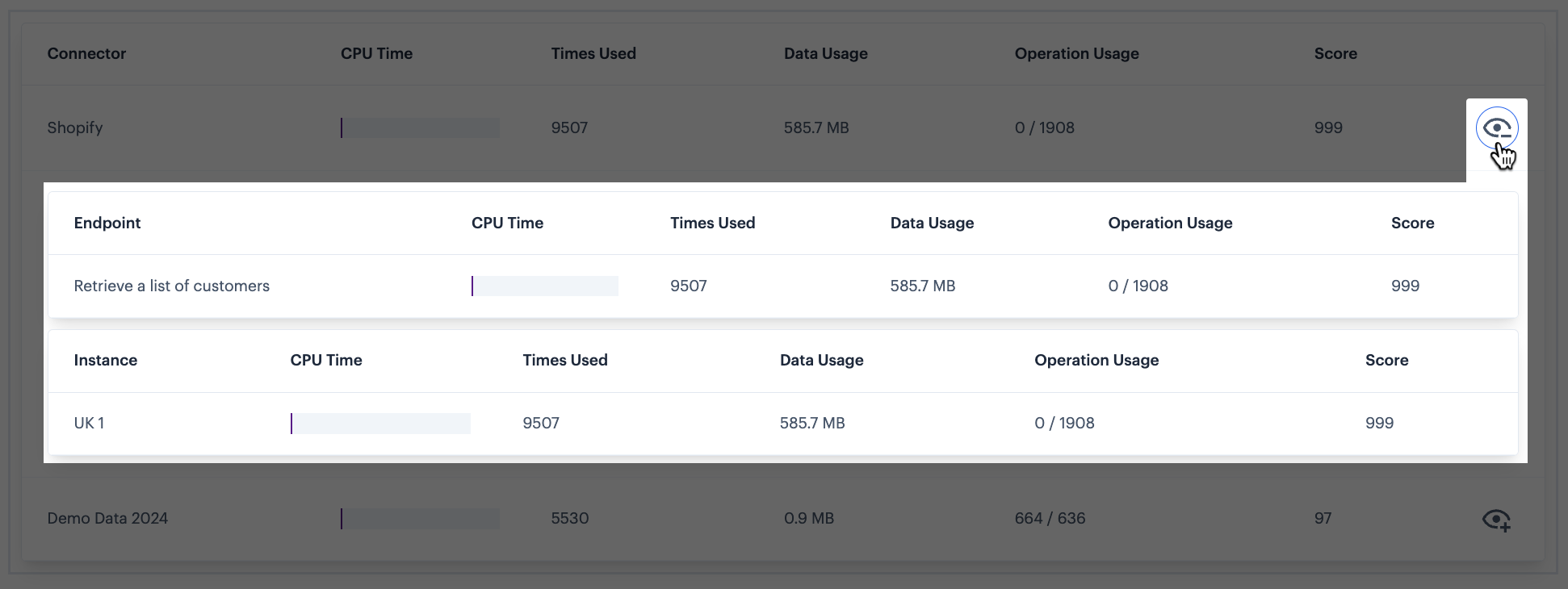
To view more details for an entry, click the associated 'view' icon - here you'll see a breakdown of the specific connector endpoints and instances that were used  (in the selected month):

<figure><img src="/files/Zn66v3iTS1BJwTQJbnCO" alt=""><figcaption></figcaption></figure>

#### Shape data

When [shape data is selected](#data-selectors), you'll see a list of shapes that have been used in process flows, within the selected month:

<figure><img src="/files/EgGtAKKbQVCCKTjPGssf" alt=""><figcaption></figcaption></figure>

For each entry, you can see the shape name, CPU time used, the number of times used, data usage, and [operation usage](/product-documentation/company-management/company-insights/company-insights-overview/about-operations.md). &#x20;

## Tracked data graph

The **tracked data** chart provides a visual representation of records that have been tracked for the selected time period:

<figure><img src="/files/sAzR8D1g4FREtS2R1bSn" alt=""><figcaption></figcaption></figure>

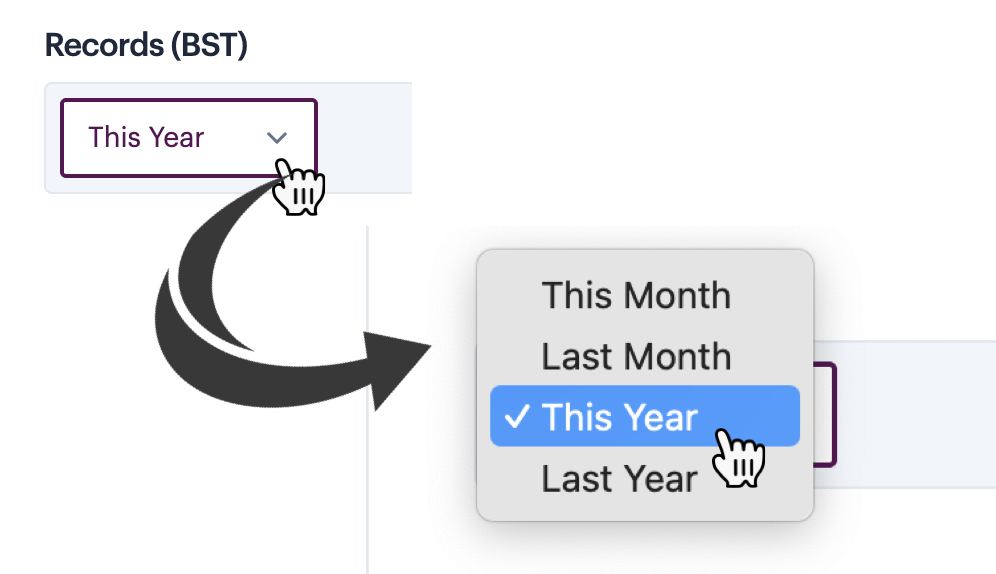
You can interact with this chart in several ways:

<table data-card-size="large" data-view="cards"><thead><tr><th></th><th></th><th></th></tr></thead><tbody><tr><td><strong>Choose a time period</strong><br>You can use the time period selector to choose which records to view:</td><td><img src="/files/vh8bkROk365V346zag6N" alt=""></td><td></td></tr><tr><td><strong>Choose the data direction to view</strong><br>You can choose to view inbound (received) operations or outbound (sent) operations:</td><td><img src="/files/4qL32SRDAYgCePSHazYj" alt=""></td><td></td></tr><tr><td><strong>View details</strong><br>Hover your cursor over any point to view operation details:</td><td><img src="/files/aU896HhrDd2y1nZLmHch" alt=""></td><td></td></tr></tbody></table>

## Managed company insights

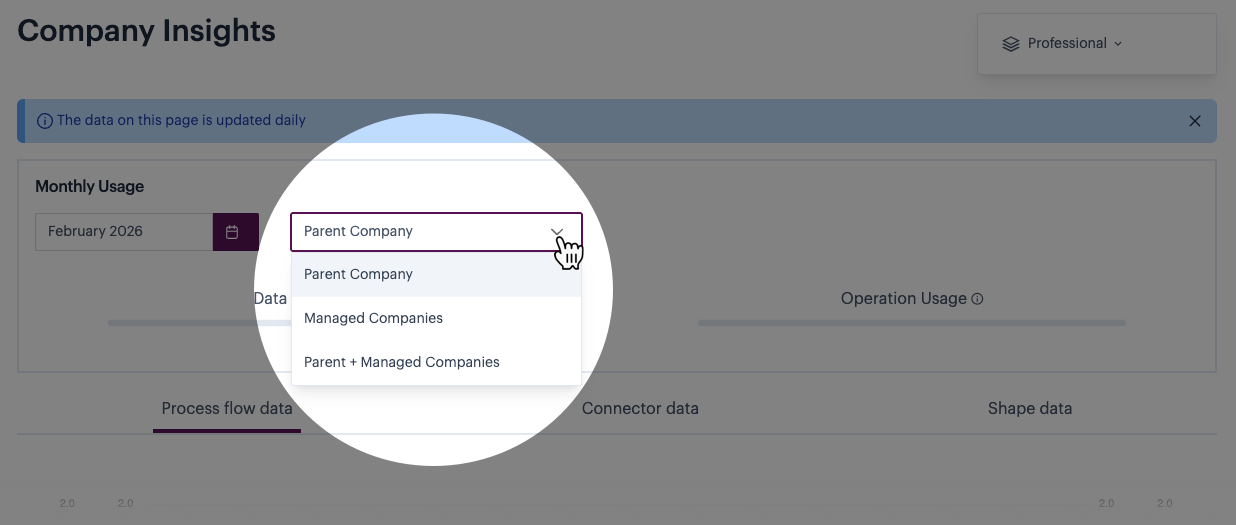
If you manage multiple company profiles, you'll see a selector at the top of the page, defaulting to `parent company` (i.e. your company):

<figure><img src="/files/T4UFXpe3CQpJp6ywmX5H" alt=""><figcaption></figcaption></figure>

You can use this to view aggregated insights for your `managed companies`. For example:

<div align="left"><figure><img src="/files/rKLTIe7KwxAZ1z1SNDBF" alt=""><figcaption></figcaption></figure></div>

Having selected this option, you'll see a snapshot panel with aggregated totals for your linked companies, followed by usage breakdown for each company that's linked to your profile.

Alternatively, select the `parent+managed companies` option to include your own (parent company) usage in the aggregated totals. For example:

<figure><img src="/files/sRuWMaYiak6wlp0VAv91" alt=""><figcaption></figcaption></figure>

In this case, the company breakdown includes totals for the parent company, followed by managed companies.&#x20;

{% hint style="info" %}
If you want to see full company insights for a managed company, you should [switch to that company](/product-documentation/company-management/multi-company-profiles/switching-in-and-out-of-a-linked-company.md) and [access company insights](/product-documentation/company-management/company-insights/accessing-your-company-insights.md) in the usual way.
{% endhint %}

## Annual billing profiles

For organisations with an annual billing agreement, an `annual usage` section is displayed at the top of the insights page, showing cumulative data and operations usage. For example:

<figure><img src="/files/Di7sQcUfuQPRqwq3rbwf" alt=""><figcaption></figcaption></figure>

By default, you'll see usage totals since the start of your billing cycle, but you can set a custom date range if needed:

<div align="left"><figure><img src="/files/Cj71A49VXhl1qhGMqyxH" alt=""><figcaption></figcaption></figure></div>

Additionally, profiles associated with an annual billing agreement will see a `this year` summary in the navigation sidebar (instead of `this month`). For example:

<div align="left"><figure><img src="/files/A68thelcyzcisaXtrGBC" alt=""><figcaption></figcaption></figure></div>

## Related information

* [Viewing logs](/product-documentation/process-flows/error-reporting-and-exception-handling/run-logs-and-queue/working-with-run-logs/viewing-detailed-logs-for-a-flow-run.md)


---

# Agent Instructions: Querying This Documentation

If you need additional information that is not directly available in this page, you can query the documentation dynamically by asking a question.

Perform an HTTP GET request on the current page URL with the `ask` query parameter:

```
GET https://doc.wearepatchworks.com/product-documentation/company-management/company-insights/company-insights-overview.md?ask=<question>
```

The question should be specific, self-contained, and written in natural language.
The response will contain a direct answer to the question and relevant excerpts and sources from the documentation.

Use this mechanism when the answer is not explicitly present in the current page, you need clarification or additional context, or you want to retrieve related documentation sections.